











Draw to Goal
Mastering the Creative Canvas of Draw to Goal
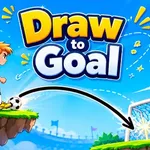
In the realm of browser-based physics puzzles, few titles demand as much spatial intuition as this one. Players engage with a minimalist interface that transforms a blank screen into a playground for kinetic energy. Every session requires precise, calculated inputs to manipulate the environment, ensuring the soccer ball reaches its destination without succumbing to gravity or stage hazards.
Understanding how to play Draw to Goal effectively starts with recognizing the weight of your lines. Unlike traditional platformers, your primary tool acts as a physical barrier and a guide, dictating the vector of the ball the moment it contacts your drawn ink. This fundamental interaction defines the entire gameplay loop.
- Line Tension: Thicker lines provide more stability for the ball.
- Velocity Retention: Smooth, curved paths preserve kinetic energy better than sharp, jagged corners.
- Impact Points: Positioning your drawing to intersect with the ball at specific angles creates predictable bounces.
Intuitive Interface and Mechanics
The game engine relies on a lightweight physics simulation that translates mouse drags into tangible, solid geometry. When you execute a stroke, the game immediately renders that path as a rigid body. Mastering the Draw to Goal mechanics involves learning how these rigid bodies interact with the ball's collision box. Players often fail by drawing too close to the starting point, leaving no room for the ball to gain necessary acceleration.
Because the game operates on a browser-based HTML5 framework, the response time is crisp and immediate. There is zero input lag between your cursor movement and the generated path. This responsiveness is critical when you are attempting to draw complex spiral ramps or intricate loops designed to bypass moving obstacles.
Technical Telemetry and Performance Metrics
| Metric | Data Specification |
|---|---|
| Developer | Fennec Labs |
| Release Date | 15 July 2026 |
| Engine | Unity WebGL |
| Platform | Web Browser |
| Genre | Physics Puzzle |
The technical foundation provided by Fennec Labs ensures that the Draw to Goal physics puzzle remains accessible across various hardware configurations. Whether you are playing on a high-end desktop or a mobile tablet, the collision detection remains consistent. This stability is vital for players who rely on frame-perfect timing to bypass spinning blades or shifting platforms.
Optimizing your performance requires an understanding of the engine's limitations. Drawing excessively long paths can sometimes cause the physics to jitter if the path contains too many vertices. Keep your lines efficient and purposeful to ensure the simulation remains buttery smooth, even in the most chaotic levels.
Pro-Tip: Always draw your initial path slightly ahead of the ball's current trajectory. This creates a 'pull' effect, ensuring the ball maintains its momentum as it traverses your custom-built ramp.
Navigating the Hazards of Draw to Goal
As you advance, the challenge shifts from simple pathing to complex obstacle management. You will frequently encounter stages where the goal is blocked by moving hazards that cycle in rhythmic patterns. Successfully navigating these requires more than just creativity; it demands a deep understanding of timing and speed control.
The best Draw to Goal strategy often involves waiting for the 'dead zone' in a hazard's animation cycle. By observing the pattern for a few seconds before committing your ink, you can time the ball's arrival to coincide with the safest window. This patient approach is the hallmark of a veteran puzzle solver.
Overcoming Dynamic Obstacle Sets
Moving barriers are the primary failure state for most newcomers. If your path intersects with a moving hazard, the resulting collision will often send the ball flying off-course or stop it dead. To mitigate this, focus on creating 'buffer zones'—gaps in your path that allow the ball to roll freely for a split second before hitting the next segment of your design.
Furthermore, pay close attention to the environmental physics. Some levels feature surfaces that accelerate the ball, while others introduce friction modifiers. Learning to account for these variables is essential when you want to master the Draw to Goal mechanics during the later, more demanding stages of the game.
Advanced Techniques for Precision Pathing
Beyond basic ramps, high-level play involves utilizing the geometry of the level itself. Walls, ceilings, and fixed obstacles can serve as powerful tools for redirection. If you cannot draw a direct line to the goal, look for a rebound opportunity. Bank the ball off a wall to bypass a guarded area, effectively treating the entire stage as a giant billiard table.
Consistency is key when attempting these advanced maneuvers. Because the physics simulation is deterministic, the same path drawn in the same location will yield the same result every time. If a specific trick shot fails, you can refine your line by just a few pixels and try again until the trajectory is perfect.
Optimizing Momentum and Bounce Angles
To maximize your success rate, focus on the curvature of your lines. Abrupt changes in direction often lead to a loss of momentum, which can cause the ball to stall before reaching the goal. Instead, use wide, sweeping curves that maintain the ball's velocity throughout its travel. This is a core component of the best Draw to Goal strategy.
Additionally, consider the angle of incidence when planning your bounces. A shallow angle against a wall will preserve more speed than a direct, perpendicular impact. By manipulating these angles, you can guide the ball through extremely tight gaps that would otherwise be impossible to clear with a standard, linear path.
Frequently Asked Questions About Draw to Goal
How can I stop the ball from stalling on long, complex paths?
Stalling usually happens when the path has too much friction or abrupt turns. To fix this, simplify your design by using fewer, smoother curves. Ensure your ramps have a consistent downward slope to keep gravity working in your favor, which helps maintain the necessary momentum to reach the goal.
Are there multiple ways to solve a single level?
Absolutely. The game is designed to reward creative thinking. You can often reach the goal using a direct, high-speed approach or a more elaborate, multi-bounce trajectory. Experimenting with different line placements is highly encouraged, as many levels have hidden solutions that are far more efficient than the obvious ones.
What is the most important skill for late-game progression?
Timing is the most critical factor. In the advanced stages, you must sync your path drawing with the movement of hazards. Spend time observing the patterns of moving obstacles before you draw your first line, as this prevents the frustration of failed attempts caused by premature launching.